
Leads are the foundation of every growing business.
Why? Because speed matters, 78% of deals go to the first responder.

The concept sounds simple, but the impact is anything but.
In practice, lead distribution is how you make that speed happen. It routes incoming leads to the right sales reps instantly. In this way, your team can respond faster, have better conversations, and convert more opportunities.
What will you gain from this guide on lead distribution? More than just the basics.
We’ll break down:
- What lead distribution really means
- How a lead distribution strategy shapes your sales process
- What the lead distribution process looks like in action
So you don’t just learn the concept, you learn how to make it work for your business.
What Is Lead Distribution?
Lead distribution is the process of routing new leads to sales reps based on criteria such as region, workload, or product expertise. Some teams manage it manually, while others use CRM and lead routing tools to automate the handoff, depending on what fits best with their setup.
A strong lead distribution strategy helps your team work smarter. It makes sure leads don’t pile up on one rep’s plate while others sit idle. It routes leads based on experience, workload, or territory, making sure no one’s overwhelmed and every lead gets timely attention.
What Is a Lead Distribution Strategy?
A lead distribution strategy is all about putting a smart system in place to make sure every lead goes to the sales rep best equipped to handle it. Instead of sending leads out randomly, teams set clear guidelines matching leads based on experience, availability, or product knowledge, so no opportunity slips through the cracks.
The goal of a lead distribution strategy is to optimize sales performance by:
- Leads are assigned to the right reps
- Creating a balanced workload for the sales team
- Reducing delays in response times, leading to improved customer satisfaction and higher conversion rates
Lead Distribution Process: How Lead Distribution Works in CRMs
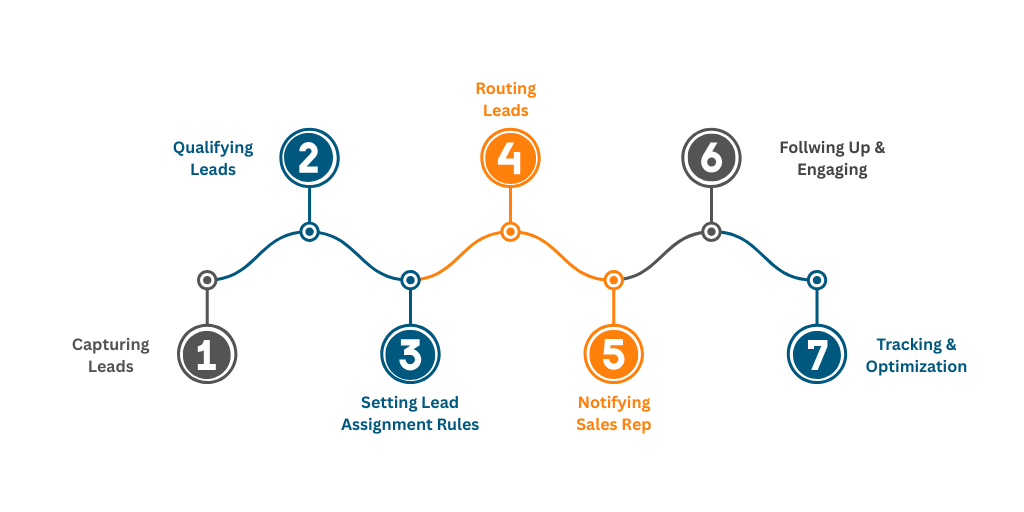
An effective lead distribution process ensures that every incoming lead is captured, evaluated, and assigned to the right sales rep without delays. A well-designed lead distribution system combines data, automation, and clear rules to improve response time and conversions.
Here’s a detailed breakdown of each stage:
1. Lead Capture
This is the starting point of the lead distribution process, where leads enter your system from multiple channels.
- Common sources include:
- Website forms
- Paid ads and campaigns
- Events and webinars
- Referrals and inbound calls
All these leads are automatically stored in a CRM or a dedicated lead distribution solution, ensuring a centralized database. According to industry practices highlighted by platforms, capturing leads in real time is crucial to avoid delays in follow-up.
Why it matters: Without proper capture, leads can be lost before they even enter your pipeline.
2. Lead Qualification
Once leads are captured, the next step is to assess their quality and readiness to buy.
- Leads are evaluated using models like BANT (Budget, Authority, Need, Timeline)
- Systems also use behavioral and demographic data for scoring
- Duplicate or low-quality leads are filtered out
This step is essential for building an automated lead distribution strategy, as it ensures only relevant and high-potential leads move forward.
Why it matters: It prevents sales teams from wasting time on unqualified leads and improves conversion efficiency.
3. Assignment Rules
At this stage, businesses define how leads should be routed within the lead distribution system.
Common criteria include:
- Territory or geography
- Product or service interest
- Deal size or account value
- Sales rep expertise or role
- Availability or workload
Modern CRMs and lead distribution tools allow these rules to be configured dynamically, forming the backbone of an automated lead distribution setup.
Why it matters: Clear rules ensure leads are matched with the most suitable sales rep, improving both speed and personalization.
4. Distribution Execution
This is where the actual assignment happens using the defined rules and chosen lead distribution strategy.
Common Methods:
Manual Lead Distribution
- Leads are assigned manually by managers
- ✔ Simple and flexible
- ✖ Time-consuming and prone to bias
Round-Robin Distribution
- Leads are distributed evenly among reps
- ✔ Fair and consistent
- ✖ Ignores rep expertise or lead complexity
Cherry-Picking
- Reps choose leads from a shared pool
- ✔ Encourages ownership
- ✖ Hard to scale, may leave some leads untouched
Automated Lead Distribution
- Leads are assigned using rules, scoring, and rep availability
- ✔ Fast, scalable, and efficient
- ✖ Can require setup and tools
This stage represents the core of any lead distribution solution, especially when automation is involved.
Why it matters: Efficient execution ensures no lead sits idle and every opportunity is acted on quickly.
5. Follow-Up & Tracking
Once leads are assigned, continuous monitoring becomes essential.
- Track response times and engagement
- Measure conversion rates
- Automatically reassign leads if no action is taken
- Maintain activity logs for accountability
Advanced systems enable automated lead distribution with built-in tracking, ensuring that no lead is ignored.
Why it matters: Speed is critical; faster follow-ups significantly increase the chances of conversion.
Lead Distribution Best Practices
Sales lead distribution strategies are not just about assigning leads. The mechanics are simple, but without the right processes, leads don’t get followed up on. This leads to missed opportunities and ongoing lead leakage.
The real challenge isn’t lead distribution. It’s everything around it.
Many business leaders realize too late that effective lead transfer depends on strong foundations, clear processes, accountability, and alignment between marketing and sales.
Consider these sales lead distribution best practices as you design your lead transfer process. Because getting this right is what turns lead flow into real revenue impact.
1. Customize Routing Rules for Precision
Generic routing is dead (precision routing is in). Every sales team operates differently, and your routing logic should reflect that reality instead of forcing leads into a one-size-fits-all system. When you assign leads based on geography, product interest, and intent signals, you’re not just distributing leads; you’re matching opportunities with the right expertise. The real shift here is moving away from broad rules to highly specific ones powered by lead distribution automation software, because tighter alignment between lead and rep is what actually drives conversions and better customer experiences.
2. Align Lead Distribution with Sales Goals
Disconnected routing is dead (goal-driven routing is in). Too many teams treat lead assignment as an operational task instead of a strategic lever. If your goal is revenue growth, high-value leads should be prioritized. If speed matters, inbound leads should be routed instantly. If efficiency is the focus, workload balancing becomes critical. The point is your automated lead distribution software for sale shouldn’t just move leads around; it should actively support what your business is trying to achieve. Otherwise, you’re optimizing activity, not outcomes.
3. Leverage Automation (But Keep It Smart)
Blind automation is dead (intelligent automation is in). Yes, automation is essential; it speeds up assignments, reduces manual errors, and ensures faster response times. But not every lead should be treated the same. High-value or strategic accounts still need human context and personalization. The best teams use automated lead distribution software to handle scale while reserving human effort for deals that actually move the needle. Automation should make your team faster, not robotic.
4. Track, Measure, and Optimize Continuously
Set-it-and-forget-it routing is dead (continuous optimization is in). Even the best sales lead distribution software won’t perform well if you’re not actively monitoring it. Response times, conversion rates, and lead leakage tell you what’s working and what’s breaking. The teams that win are the ones that constantly refine their routing logic based on data, not assumptions. Because in reality, lead distribution isn’t a setup; it’s an ongoing process.
5. Ensure Fair and Transparent Distribution
Opaque systems are dead (transparent distribution is in). If your reps don’t understand how leads are assigned, trust breaks down fast. Fair methods like round-robin or performance-based routing help maintain balance, but transparency is what keeps teams aligned. When your lead distribution automation software is clear and consistent, it eliminates internal friction and keeps reps focused on selling instead of questioning the system.
6. Recognize and Reward Top Performers
Ignoring performance is dead (incentivized selling is in). Your lead distribution strategy should do more than assign leads; it should motivate your team. By tracking performance and rewarding top reps with better opportunities or incentives, you reinforce what success looks like. This is where the real benefits of using lead distribution software show up, not just in efficiency, but in building a high-performing sales culture that drives revenue.
7. Stay Flexible and Open to Change
Rigid processes are dead (adaptive systems are in). What works today might not work tomorrow, and the best teams accept that early. Whether it’s testing round-robin, rules-based, or fully automated approaches, flexibility is key. Even the most advanced automated lead distribution software for sale needs regular fine-tuning based on feedback and results. The goal isn’t to find a perfect system; it’s to build one that evolves with your sales motion.
8. Balance Automation with Personalization
One-size-fits-all outreach is dead (context-driven engagement is in). Not every lead deserves the same level of attention. High-intent or high-value prospects need deeper research and tailored conversations, while lower-priority leads can move through automated flows. The smartest teams combine automation with personalization, using tools to scale efficiently while still making key prospects feel understood. That balance is what ultimately maximizes both deal size and conversion rates.
How to Choose the Best Lead Distribution Software
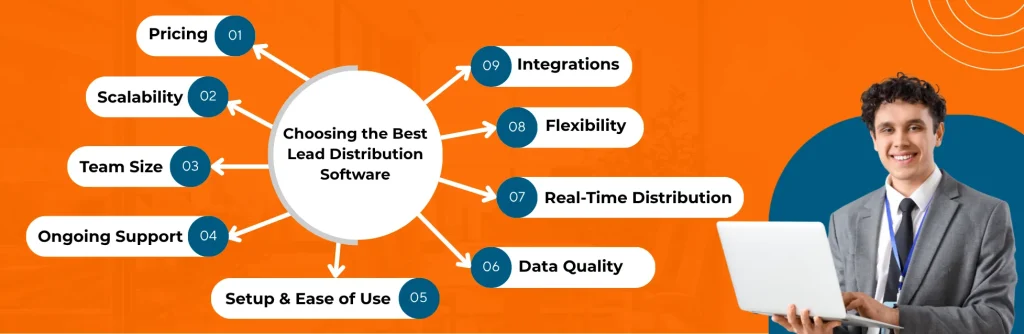
Choosing the right lead distribution software can feel straightforward at first.
You just need something that assigns leads… quickly… fairly… automatically.
But like most initial ideas, that’s still a bit too vague.
Because when you say “lead distribution software,” what do you actually need it to do in your business?
Do you need speed?
Fairness?
Better conversions?
Cleaner data?
Less manual work?
When you start asking those questions, you move from “we need a tool” to “we need the right tool for how we operate.”
And that’s where better decisions come from.
Here are the key factors you should evaluate:
1. Pricing
Most people start here. And that makes sense.
But “pricing” on its own isn’t the real question.
The better question is, what is this going to cost us over time—and what are we getting in return?
Because the cheapest option often comes with trade-offs:
- Limited features
- Manual workarounds
- Poor scalability later
Look beyond the base price:
- Are you paying per user, per feature, or per lead volume?
- Are there hidden costs for onboarding, setup, or integrations?
- Will you need to upgrade quickly as you grow?
👉 Tip: Don’t choose the cheapest tool. Choose the one that removes the most friction from your process.
2. Scalability
At the beginning, most tools feel like they “work.”
But the real test is:
Will it still work when your lead volume doubles—or triples?
Because growth creates pressure:
- More leads coming in
- More reps to assign
- More territories, products, and rules
And simple systems start to break.
You might find yourself:
- Manually reassigning leads
- Creating workarounds
- Losing leads in the process
Scalability isn’t about today.
It’s about whether the system can keep up with where you’re going.
3. Your Team Size
Your team structure shapes everything.
But again, the real question isn’t just “how big is your team?”
It’s:
How does your team actually work?
For example:
- A small team might only need simple round-robin routing
- A growing team may need territory or product-based rules
- A large team often needs logic based on availability, workload, or specialization
Because as teams grow, new problems show up:
- Some reps get too many leads
- Others don’t get enough
- Follow-ups slow down
The bigger the team, the more important balance and fairness become.
4. Ongoing Support
Support is easy to overlook… until something breaks.
And in lead distribution, when something breaks, it’s not just a technical issue.
It’s missed opportunities. Lost revenue. Slower response times.
So instead of asking
“Does this tool have support?”
Ask:
- Will someone help us set this up properly?
- Is training included?
- How fast can we get help if routing stops working?
👉 Why it matters: Even small routing errors can have a direct impact on pipeline and revenue.
5. Setup & Ease of Use
A tool can be powerful… and still not be usable.
This usually shows up after implementation:
- Only one person understands how it works
- Changes take too long
- The team avoids using it
So the better question is:
Can your team actually use and manage this without friction?
Look for:
- No-code or low-code rule builders
- Clear, intuitive interfaces
- Quick setup and iteration
Because if it’s too complex, it slows everything down.
6. Available Integrations
Most tools don’t work in isolation.
Your lead distribution software sits in the middle of:
- Your CRM (like Salesforce or HubSpot or MS Dynamics)
- Marketing automation tools
- Enrichment lead distribution platforms
- Communication tools
So the real question becomes:
How well does this tool connect with everything else you’re already using?
Without strong integrations, you’ll end up with:
- Data silos
- Manual updates
- Inconsistent information
And that leads to poor routing decisions.
7. Routing Complexity & Flexibility
This is where things get real.
Because not all businesses need the same level of complexity.
Some just need:
- Round-robin distribution
- Basic territory rules
Others need:
- Product-based routing
- Region-specific assignments
- Lead source logic
And then some teams need the following:
- Lead scoring
- Rep availability
- Capacity-based distribution
- Performance-based routing
So instead of asking:
“Does it support routing?”
Ask:
Does it support our level of complexity, now and later?
👉 Important: The more products, regions, or segments you have, the more detailed your routing logic needs to be.
8. Speed & Real-Time Distribution
Speed sounds like the obvious goal.
But it’s worth asking:
Why does speed matter in your process?
Is it because:
- You want faster lead response times?
- You’re losing leads due to delays?
- Your reps need instant visibility?
Because “speed” on its own isn’t the outcome.
The outcome is:
- Higher conversion rates
- Better customer experience
- More deals closed
So look for:
- Instant lead assignment
- Real-time notifications
- SLA tracking
Speed is valuable, but only when it supports better decision-making and action.
9. Data Quality & Enrichment
Finally, there’s something many teams overlook:
Even the best routing logic fails… with bad data.
So the real question is:
How good is the data going into your system?
Because if your data is incomplete or inconsistent:
- Leads get misrouted
- Reps don’t have context
- Follow-ups become less effective
Look for:
- Lead validation before routing
- Enrichment (firmographics, intent signals)
- Data standardization
Clean data doesn’t just improve routing; it improves everything downstream.
Improve Lead Management with a Lead Distribution System
By now, it’s clear that lead distribution isn’t just a feature. It’s a critical part of how modern sales teams operate and grow.
The right lead distribution system doesn’t just assign leads. It shapes how quickly your team responds, how efficiently they work, and how consistently you convert opportunities into revenue.
Choosing the right solution can significantly impact your sales and marketing performance. That’s why it’s important to go beyond surface-level features and focus on what truly fits your process.
Take the time to:
- Understand your routing needs
- Evaluate flexibility and scalability
- Compare how different systems align with your workflow
With the right lead distribution system in place, you can streamline your lead flow, improve response times, and ensure every opportunity is handled the right way.
Want to see how this can work for your business?
Explore how the right lead distribution approach can help you optimize your sales process, reduce lead leakage, and drive better results.
See How LeadAngel Can Transform Your Lead Management
Curious to experience the power of LeadAngel firsthand? We understand!
We're offering a complimentary trial so you can explore LeadAngel's features at your own pace. Once you request a free trial, we'll schedule a personalized onboarding session to ensure you maximize the value of LeadAngel.
Ready to take your lead management strategy to the next level? Request your LeadAngel trial today!
In addition to exploring the platform, we recommend visiting our LeadAngel Help Center for in-depth guidance. Our dedicated customer support team is also available to answer any questions you may have at sales@leadangel.com.
FAQs
It automatically assigns incoming leads to the right sales reps based on rules like territory, availability, skills, or lead score so no manual routing is needed.
It distributes leads evenly across reps in a rotating order, ensuring fair workload and equal opportunity.
It’s the flow of capturing, qualifying, and assigning leads to the most relevant sales rep for follow-up.
It reduces response time, eliminates manual work, prevents lead leakage, and ensures every lead is followed up quickly.
It matches leads with the most suitable reps (based on expertise, location, or behavior), leading to better conversations and higher chances of closing.
If leads are delayed, misassigned, ignored, or unevenly distributed—your process needs optimization.
It’s the automated assignment of leads within a CRM system to sales reps using predefined rules and workflows.
It’s a method where leads are assigned sequentially to reps in a loop to maintain fairness and balance.
It ensures leads are acted on quickly and by the right person—directly impacting conversions and revenue.
It uses software to instantly route leads without human intervention, based on set conditions and logic.

