Key Takeaways:
- This comparison of LeadAngel vs Close CRM focuses specifically on lead routing, lead-to-account matching, territory assignment, and RevOps workflow management—not just general CRM functionality.
- LeadAngel and Close CRM solve different challenges within the revenue workflow. LeadAngel focuses on lead routing, lead-to-account matching, territory management, and RevOps workflow automation. Close CRM is primarily designed for sales execution, communication, and pipeline management.
- LeadAngel is designed for lead management, including operational routing workflows, territory-based assignment, weighted distribution, queue management, and inbound SQL routing across all CRMs.
- Organizations managing ABM motions, complex territories, or high inbound volume typically require specialized routing capabilities.
Choosing between LeadAngel and Close CRM depends on where your revenue operations challenges exist and what problem your sales team is trying to solve.
Some organizations struggle with rep productivity, outreach execution, and pipeline tracking. Others struggle with lead ownership conflicts, routing delays, duplicate records, and territory alignment.
Close CRM and LeadAngel approach these challenges differently
If your team focuses on inbound execution, pipeline visibility, and managing communication workflows from one place, Close CRM is built for those use cases. But if you are confused about which platform is better for lead routing, lead-to-account matching, territory lead assignment, and ownership management across your GTM workflow. LeadAngel approaches the problem differently. It focuses on routing intelligence, lead-to-account matching, ownership governance, and territory management across the GTM workflow.
Close CRM is primarily designed for sales execution. It helps teams manage outreach, communication, and pipeline activity inside a centralized CRM environment.
In this comparison, we’ll break down how both platforms handle routing flexibility, CRM coordination, lead assignment, scalability, and operational fit, so you can evaluate which platform aligns better with your sales infrastructure and routing requirements.
What is LeadAngel?
LeadAngel is a lead routing RevOps workflow platform designed to help sales teams automate lead assignment, accounts, and ownership management across the sales funnel. It is built specifically for routing operations and does not focus on storing customer problems, unlike traditional CRMS.
It gives teams more control over how inbound leads are assigned, matched, distributed, and tracked across territories and sales teams. Instead of replacing CRM systems, it works alongside platforms such as Salesforce, HubSpot, and Microsoft Dynamics to improve routing accuracy and operational efficiency
Some of LeadAngel’s core capabilities include:
- Territory-based lead routing
- Account matching and lead-to-account mapping
- Round-robin and weighted lead assignment
- Duplicate detection and data deduplication
- Routing workflows built for complex sales structures
- Real-time routing automation
- Scheduling and handoff workflows
LeadAngel is especially useful for growing B2B companies where routing logic becomes increasingly complex across territories, products, and account ownership structures.
What Is Close CRM?
Close is used by sales teams that want to run outreach, manage deals, and track conversations in a unified CRM environment.
Close assists SDRs and AEs in executing outreaching, managing follow-ups, and tracking opportunity progression within a single operational layer. Hence, it reduces reliance on external sales engagement tools.
For teams primarily focused on outbound motion and active deal management, this setup supports more streamlined execution across the sales cycle.
Core capabilities include:
- Built-in calling and SMS functionality
- Email sequences and sales automation
- Pipeline and opportunity management
- Workflow automation
- Contact and lead management
- Sales activity tracking and reporting
- Basic lead assignment and distribution workflows
- CRM integrations and sales workflow synchronization
As you already know, Close is particularly effective for organizations focused on sales engagement and pipeline execution. However, compared to dedicated RevOps platforms, its capabilities around advanced lead routing, territory management, account matching, and ownership orchestration are relatively more limited.
LeadAngel vs Close CRM: Head-to-Head comparison
Before choosing between LeadAngel and Close, it is important to compare how each platform handles workflow control across the funnel.
| Features | LeadAngel | Close |
|---|---|---|
| Core Focus | Built for lead routing, account matching, and RevOps workflows | Designed for sales communication and pipeline execution |
| Lead Assignment | Supports advanced routing rules, weighted distribution, queues, and ownership-based assignment | Facilitate basic lead assignment and workflow automation |
| Routing Flexibility | Allows routing based on territories, account ownership, geography, and custom logic | Better suited for simpler routing workflows |
| Lead-to-Account Matching | Native lead-to-account matching with ownership alignment | No dedicated lead-to-account matching functionality has been publicly highlighted |
| Territory Management | Supports territory-driven routing and assignment management | Limited support for advanced territory structures |
| Workflow Automation | Designed for operational workflows and routing automation | Focused more on sales task automation and outreach workflows |
| CRM Ecosystem Alignment | Engineered to work alongside all CRMs, including Salesforce, HubSpot, and Microsoft Dynamics, to manage lead routing and territory-based assignment across the revenue workflow. | Functions primarily as an independent CRM platform with native sales workflows and API-based integrations. Close does not provide native Salesforce CRM support for workflows. |
| Duplicate Management | Involves duplicate prevention and data cleanup workflows | Limited publicly documented deduplication capabilities |
| Sales Engagement | Includes scheduling and real-time handoff support | Strong built-in calling, SMS, and email sequencing features |
| Real-Time Routing | Assists with instant lead routing and automated ownership updates | Supports workflow automation with less routing depth |
| Reporting & Visibility | Provides routing visibility and operational reporting | Focuses on sales activity and pipeline reporting |
| Scalability | Better suited for complex RevOps, Sales team environments, and growing GTM teams | Best for SMB and outbound-focused sales teams |
| Pricing | Custom pricing plans available | Starts with 35$/per seat/ per month |
| Best Fit | RevOps and growing GTM teams | Outbound sales team |
Which One to Choose between LeadAngel & Close CRM? (A Quick Decision Guide)
The decision between LeadAngel and Close depends less on company size and more on operational complexity.
Both platforms support sales teams, but they solve different problems inside the sales funnel. Close is primarily optimized for sales execution and communication workflows. LeadAngel is optimized for routing governance and RevOps process control.
The right choice depends on how your GTM motion operates today and where operational friction is slowing down pipeline progression.
Which Should You Choose?
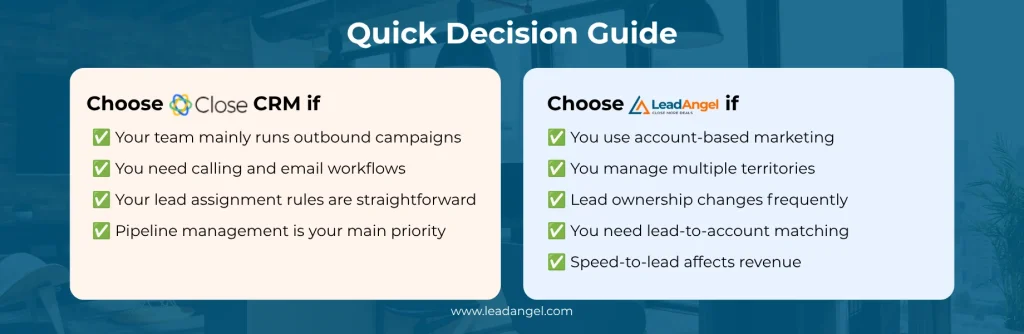
Choose Close CRM
If your sales team primarily needs a centralized CRM for outbound execution, pipeline management, email sequencing, calling workflows, and rep productivity, then opt for Close. Close is generally better suited for SMB and mid-market sales environments where lead assignment logic is relatively linear, and RevOps dependencies are limited.
It performs well when your primary operational focus is on outbound sequencing, pipeline management, rep activity execution, and opportunity progression.
Ideal For: Sales teams managing outbound-heavy GTM motions, simplified lead distribution models, and centralized communication workflows without advanced territory routing or lead-to-account matching requirements.
Choose LeadAngel:
If your setup involves more complex routing logic, like territory-based assignment, lead-to-account matching, SLA rules, SDR-to-AE handoffs, and shared ownership across tools, all CRMs, then LeadAngel tends to fit better.
It’s built for RevOps teams that are dealing with ABM programs, enterprise account structures, weighted distribution models, and high-volume inbound SQLs where manual routing quickly breaks down.
In these environments, the focus shifts from just assigning leads to ensuring every lead reaches the right owner, with the right context, at the right time.
Strengths & Limitations of LeadAngel Vs Close CRM

Before deciding which platform is the better fit, it’s important to understand the strengths and limitations of both LeadAngel and Close.
Strengths & Limitations of LeadAngel:
LeadAngel Strengths
- Flexible lead routing built for complex sales processes.
- Strong lead-to-account matching for cleaner CRM management.
- Keeps account ownership aligned across teams and systems.
- Supports territory-based workflows with advanced customization.
- Automates lead routing in real time to reduce response delays.
Potential Limitations
- Advanced workflows may require careful setup and planning.
- Best suited for teams with more complex routing needs.
- Some advanced use cases may require RevOps involvement.
Strengths & Limitations of Close:
Close Strengths
- Built-in calling, email, and SMS tools keep sales communication centralized.
- Designed for fast outbound sales workflows and high-volume prospecting.
- Streamlined interface helps sales reps stay focused on deals and follow-ups.
- Quick lead navigation and dialer features improve outreach efficiency.
- Easy-to-use experience supports faster onboarding and adoption for sales teams.
Potential Limitations
- Limited workflow support beyond calls, outreach, and deal management.
- Follow-through and next steps rely heavily on manual discipline.
- Cross-functional collaboration features are relatively limited.
- Teams may need additional tools for operations, approvals, or execution workflows.
- Can become restrictive as sales processes grow more complex and interconnected.
G2 LeadAngel Vs Close CRM Reviews: Who Is Leading The Competitive Edge?
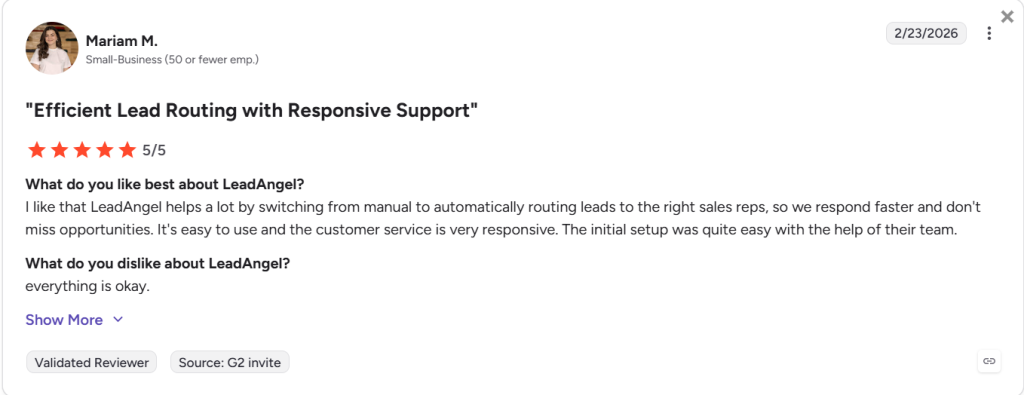
Independent review feedback from G2 adds additional perspective to this comparison between LeadAngel and Close. Both platforms are well-regarded, but users often highlight different strengths depending on their sales and operational needs.
The category-level feedback paints a clearer picture.
| Category | LeadAngel | Close | Edge |
|---|---|---|---|
| Lead Routing & Automation | 9.4 | 7.8 | LeadAngel |
| Ease of Use | 8.8 | 9.2 | Close |
| Lead-to-Account Matching | 9.3 | 7.6 | LeadAngel |
| Sales Communication Tools | 7.9 | 9.4 | Close |
| Customization & Workflow Flexibility | 9.1 | 8.0 | LeadAngel |
| Cross-functional Scalability | 9.0 | 7.8 | LeadAngel |
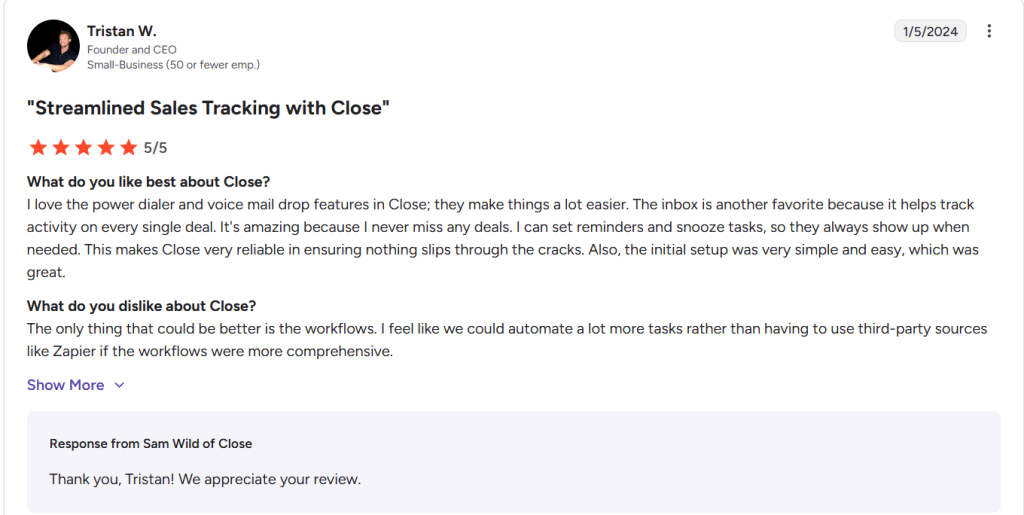
https://www.g2.com/products/close/reviews/close-review-9087574
Why Is LeadAngel A Better Alternative For Sales Teams?
Routing logic becomes more complex as sales organizations scale. RevOps teams start managing territory hierarchies, SLA enforcement, SDR-to-AE handoffs, lead-to-account matching, and account ownership across multiple systems. At that stage, routing accuracy directly affects SQL conversion rates, pipeline velocity, and customer experience.
That is where LeadAngel starts becoming a stronger alternative to Close CRM for teams dealing with operational routing complexity.
Built for Revenue Operations Workflows
Close is primarily designed for sales communication and pipeline execution. Its core strengths are calling, email automation, SMS, and rep productivity workflows.
LeadAngel operates at a different layer. Instead of functioning as another CRM interface, it integrates with all CRM systems such as Salesforce, HubSpot, and Microsoft Dynamics to centralize routing and ownership governance across the GTM stack.
This becomes especially important for organizations managing:
- ABM programs
- Multi-region territories
- Expansion and renewal motions
- Weighted round robin assignment
- Named account ownership
For many RevOps teams evaluating the best lead routing software for Salesforce, this operational flexibility becomes a key differentiator.
Better Lead-to-Account Matching
Lead-to-account matching tools directly impact pipeline integrity. Without accurate matching logic, existing prospects can enter net-new SDR cadences, duplicate outreach increases, and account engagement becomes fragmented.
Close supports lead management and sales workflows effectively, but it is not deeply specialized in lead-to-account matching
LeadAngel resolves this before the assignment occurs.
For example, if an inbound demo request comes from a subsidiary company already tied to an open enterprise opportunity, LeadAngel can:
- Match the lead to the correct Salesforce account
- Detect active opportunities
- Validate the assigned AE owner
- Route directly to the appropriate enterprise sales pod
Without this level of matching logic, leads can easily enter generic SDR queues, creating duplicate outreach and fragmented account engagement.
That difference becomes essential for enterprise sales teams running ABM or expansion-focused GTM motions.
More Advanced Routing Logic and Assignment Depth
As GTM structures grow, static assignment rules become difficult to maintain. Enterprise sales teams rarely distribute SQLs evenly across every rep because territories, rep capacity, and account value vary significantly.
Close supports basic lead assignment and workflow automation, which works well for smaller sales teams with relatively straightforward routing structures.
LeadAngel is designed to support more advanced routing models, such as:
- Territory-based routing — Routes leads using geography, segment, or ownership logic.
- Weighted assignment — Balances lead distribution based on rep bandwidth.
- Queue management — Prevents routing bottlenecks during inbound spikes.
- Time-zone-aware routing — Improves SLA adherence for global sales teams.
- Ownership synchronization — Maintains alignment between CRM ownership and routing workflows.
These capabilities give RevOps teams significantly more control over lead distribution and pipeline governance.
Stronger CRM Coordination
Most routing problems are actually coordination problems between disconnected systems.
Close centralizes sales activity and communication workflows inside a single CRM experience. For outbound-focused teams, this creates a streamlined environment for pipeline execution.
LeadAngel operates more like a RevOps routing software layer that coordinates routing logic, ownership governance, and lead distribution across connected GTM systems
A typical RevOps environment may include:
- HubSpot for marketing automation
- Salesforce for opportunity management
- ZoomInfo for enrichment
- 6sense for intent data
- Outreach or Salesloft for sequencing
As more systems enter the GTM stack, routing dependencies become harder to manage through disconnected automation rules alone.
LeadAngel centralizes:
- Ownership governance
- Routing enforcement
- Duplicate prevention
- SLA management
- Territory alignment
This helps RevOps teams maintain cleaner lead distribution and stronger pipeline visibility as operational complexity increases.
Final Words
Choosing between LeadAngel and Close CRM depends on what your sales organization needs most from the platform.
If your priority is outbound communication, pipeline visibility, and rep productivity, Close delivers a streamlined CRM experience for managing day-to-day sales execution.
If your challenge is operational complexity — such as lead routing, territory assignment, lead-to-account matching, SLA enforcement, and SDR-to-AE orchestration — LeadAngel provides much deeper control across the revenue funnel.
The best approach is to evaluate where friction exists inside your GTM workflow today. If routing inefficiencies are affecting SQL conversion, ownership alignment, or speed-to-lead, investing in a dedicated RevOps and routing platform like LeadAngel will create far more long-term operational value than relying only on standard CRM workflows.
*Disclaimer: All third-party names, logos, content, and trademarks are the property of their respective owners. These references do not imply endorsement.
See How LeadAngel Can Transform Your Lead Management
Curious to experience the power of LeadAngel firsthand? We understand!
We're offering a complimentary trial so you can explore LeadAngel's features at your own pace. Once you request a free trial, we'll schedule a personalized onboarding session to ensure you maximize the value of LeadAngel.
Ready to take your lead management strategy to the next level? Request your LeadAngel trial today!
In addition to exploring the platform, we recommend visiting our LeadAngel Help Center for in-depth guidance. Our dedicated customer support team is also available to answer any questions you may have at sales@leadangel.com.
FAQs
Close is more heavily centered around sales execution workflows such as outbound communication, opportunity tracking, pipeline management, and rep activity management inside the CRM layer. LeadAngel operates more on the RevOps side of the funnel. It focuses on lead routing, lead-to-account matching, territory assignment, and data deduplication across all CRMs. Close is a stronger fit if your priority is outbound sales activity. If your priority is routing accuracy and ownership governance across complex sales environments, LeadAngel provides deeper operational capabilities.
LeadAngel is better suited for automated lead routing because it supports territory-based routing, weighted assignment, queue management, SLA-based routing, and ownership synchronization. Close supports more basic lead assignment workflows designed for simpler sales environments.
LeadAngel provides dedicated lead-to-account matching designed to connect inbound leads with existing CRM accounts before routing occurs. This helps maintain ownership alignment and prevents duplicate outreach. Close supports lead management workflows but does not specialize in advanced lead-to-account matching.
LeadAngel includes duplicate prevention and deduplication workflows directly inside its routing infrastructure. Close focuses more on CRM activity management and provides less operational depth around duplicate governance and routing-level data cleanup.
LeadAngel is more firmly integrated into Salesforce, Microsoft Dynamics, and HubSpot routing operations. It is particularly for lead assignment, lead-to-account matching, data deduplication and ownership alignment workflows. Close supports integrations across the sales stack as well. But the core architecture is centered around CRM activity management and sales execution.
LeadAngel is better suited for complex inbound lead management as it combines lead routing, account matching, scheduling, SLA enforcement, and SDR-to-AE orchestration within a single workflow. Close is more optimized for sales engagement, pipeline management, and outbound execution.
LeadAngel provides stronger visibility into lead routing performance through routing analytics, ownership tracking, SLA monitoring, and assignment reporting. Close reporting is more focused on pipeline activity, rep productivity, and sales communication metrics.
B2B teams usually choose LeadAngel when standard CRM assignment rules stop keeping up with pipeline complexity. Once you are managing multiple territories, shared account ownership, ABM motions, inbound SLAs, and high SQL volume across CRMs, routing mistakes start affecting pipeline coverage. Response time varies quickly. At that stage, routing is no longer just an admin workflow — it becomes part of revenue execution.