Quick Summary
LeadAngel vs RevenueHero comes down to one architectural question: does your routing problem live inside the CRM, or does it live in the meeting calendar?
LeadAngel is a lead-to-account matching, routing, and meeting scheduling tool built natively for Salesforce, HubSpot, and Microsoft Dynamics 365. It is designed for RevOps teams running multi-CRM, multi-object routing at scale. Choose LeadAngel if your bottleneck is routing accuracy, territories, duplicate accounts, multi-CRM assignment, or Opportunity-level orchestration.
RevenueHero is an inbound scheduling and instant-qualification tool built to convert a form-fill into a booked meeting in seconds, purpose-built for HubSpot-first demand gen teams. Neither replaces the other’s core strength. Choose RevenueHero if your bottleneck is form-to-calendar conversion speed and inbound qualification.
This blog has covered a detailed comparison of LeadAngel and RevenueHero based on their architecture, features, G2 reviews, pricing, and more.
At A Glance
| Area | LeadAngel | RevenueHero |
|---|---|---|
| Core architecture | Routing and account-matching engine, native inside the CRM, covering Lead, Contact, Account, and Opportunity objects | Inbound scheduler and qualification layer sitting in front of website forms, optimized for speed-to-lead and booking rate |
| CRM support | Native on Salesforce, HubSpot, and Microsoft Dynamics 365 | Strongest on HubSpot and Salesforce |
| Account Matching depth | Fuzzy matching logic with 99.7% accuracy | Fuzzy account matching stops at the point a lead comes in |
| Backup coverage | Fallback Assignee reroutes at the routing-rule level, covering unavailable queue owners generally | Vacation Management swaps calendars specifically when a rep is marked OOO |
| Pricing | Custom pricing | Starts with $15/mo/user |
| Routing scope | Continues past the meeting into Opportunities | Ends once the meeting is booked |
| G2 rating | 4.5 stars | 4.8 stars |
Is your lead routing breaking down inside the CRM, or is your inbound funnel losing prospects before they ever hit a calendar?
That’s the question that usually sits behind a LeadAngel vs RevenueHero search. RevOps and demand gen leaders run into this comparison the moment their setup outgrows a native CRM assignment rules or a basic calendar tool stops keeping up with volume, territories, or form-to-meeting leakage.
Both platforms improve lead-to-meeting outcomes. They were built for different layers of the funnel:
LeadAngel is an advanced lead routing, account-matching, and meeting scheduling software. It is a multi-object, multi-CRM RevOps workflow platform that integrates with top CRMs. Whereas RevenueHero is an inbound scheduling platform. It converts a form-fill into a booked meeting in seconds, with the widget staying on your own domain.
This comparison maps the architectural differences so you can match the tool to where your real bottleneck lives—and convert evaluation into a confident shortlist..
What Is LeadAngel?
LeadAngel is an advanced lead routing, account matching, and meeting scheduling software that automatically assigns leads, contacts, accounts, and opportunities to the best-fit sales rep inside your CRM. It’s built for RevOps, MarOps, and Sales Ops teams that need assignment logic beyond a native CRM router.
LeadAngel was built for a specific, recurring problem: CRM data rot, complex routing problems, and faster meeting scheduling. Native routing tools in most CRMs handle exact-match assignment well enough. But they break down when a lead’s company name doesn’t match the account record word-by-word.
For example, “Acme Inc.” versus “Acme, Inc.” versus “acme.com” as a domain. LeadAngel use fuzzy logic for lead-to-account matching and addresses that gap with a 99.7% match accuracy rate. It runs natively inside Salesforce, HubSpot, and Microsoft Dynamics 365. LeadAngel is an ideal platform for mid-sized to enterprise-level businesses.
What separates LeadAngel from a scheduling tool bolted onto a routing feature is that routing is the entire product. It processes records without pulling them out of the CRM for external processing, which matters for audit trail integrity and data governance in regulated or enterprise environments. LeadAngel also supports SLA enforcement and live SDR-to-AE handoffs, so a lead doesn’t just get assigned — it gets tracked from assignment through first contact.
LeadAngel runs natively with:
- Salesforce lead routing
- HubSpot lead routing
- Microsoft Dynamics 365 lead routing
What Is RevenueHero?
RevenueHero (sometimes searched as “Revenue Hero”) is an inbound revenue acceleration platform that instantly qualifies, routes, and schedules meetings the moment a prospect submits a form on your website.
So, what is Revenue Hero built to solve? Speed. The platform’s core architecture is the booking widget: a scheduler embedded directly on your domain that loads in under a second and converts high-intent form-fills into calendar bookings before the prospect has a chance to close the tab.
Revenue Hero’s routing logic — round-robin, weighted, and fuzzy matching for lead-to-account assignment — exists to serve that scheduling motion. It qualifies a lead against form and enriched data, matches it to the right rep or team, and presents open calendar slots in the same flow.
The widget stays on your domain instead of redirecting to an external booking page. Marketing teams keep full attribution data on every touchpoint. That’s a meaningful advantage over tools that route visitors off-site to book.
LeadAngel vs RevenueHero: Feature Comparison
Any LeadAngel vs RevenueHero evaluation deserves more than a checklist, but a checklist is still the fastest way to see where the two platforms diverge.
| Capability | LeadAngel | RevenueHero |
|---|---|---|
| Core Architecture | Native CRM routing, matching engine, and meeting scheduling | Inbound scheduling widget with routing logic layered in |
| CRM support | Salesforce, HubSpot, Microsoft Dynamics 365 | Strongest on HubSpot; also supports Salesforce |
| Meeting Scheduling | ScheduleNow add-on for web forms and handoffs | Native, real-time instant scheduling |
| Object-level routing | Lead, Contact, Account, Opportunity | Primarily Lead/form-submission routing |
| Lead-to-account matching | Fuzzy matching, 99.7% reported accuracy | Fuzzy matching tied to the scheduling flow |
| Backup coverage | Fallback Assignee — reroutes at the routing-rule layer when a queue owner or rep is unavailable | Vacation Management — reroutes at the calendar layer when a rep marks themselves OOO |
| Data hygiene | Native Data Dedupe (merge/delete/convert) | Native enrichment add-on; no dedicated dedupe engine |
| SLA enforcement | Yes, with live SDR-to-AE handoff | Workflow automation across the meeting lifecycle |
| G2 rating | 4.5 stars | 4.8 stars |
Meeting Scheduling
This is where RevenueHero’s architecture wins outright. Instant scheduling is the native core of the product, with sub-one-second widget load times and native workflow automation across the full meeting lifecycle, from form fill to meeting held.
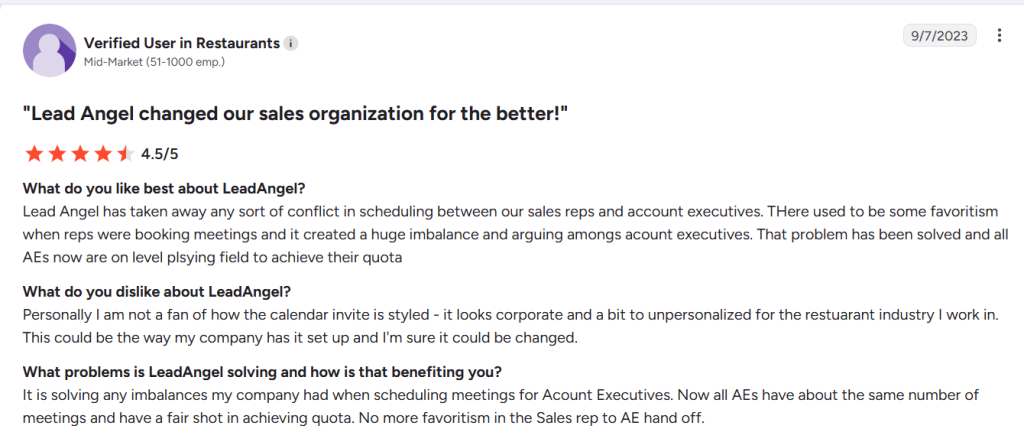
LeadAngel offers Online Scheduling and Offline Scheduling.
- Online scheduling- prospects book instantly after form submission
- Offline Scheduling- SDRs book AEs directly inside the CRM after routing
LeadAngel connects easily with Google Workspace and Microsoft 365. It supports multiple combined calendars, handles automatic time zones, and includes reminders with cancel/reschedule links.
Source: https://www.g2.com/products/leadangel/reviews/leadangel-review-8579115
Lead-to-Account Matching
Both platforms use fuzzy matching to solve the same underlying problem. LeadAngel treats this as its primary function, matching against company names, email domains, abbreviations, and spelling variations before any routing rule fires, and extends that matching logic across four CRM object types.
RevenueHero’s matching exists to serve its scheduling flow — it’s built to get a qualified lead onto the right rep’s calendar fast, and the account-matching step is one part of that pipeline rather than a standalone capability.
Backup Coverage: Fallback Assignee vs. Vacation Management
This is a genuine capability on both sides, just architected at different layers.
LeadAngel’s Fallback Assignee operates at the routing-rule level: when a queue owner or assigned rep is unavailable, the lead reroutes to a designated fallback as part of the assignment logic itself — applying to leads, contacts, accounts, and opportunities generally.
RevenueHero’s Vacation Management operates at the calendar level: a rep marks themselves out of office, and a designated backup automatically absorbs their meeting slots so prospects never hit an empty calendar. Neither is more “advanced” than the other; they’re solving the same coverage problem from different points in the pipeline.
Routing Logic and SLA Enforcement
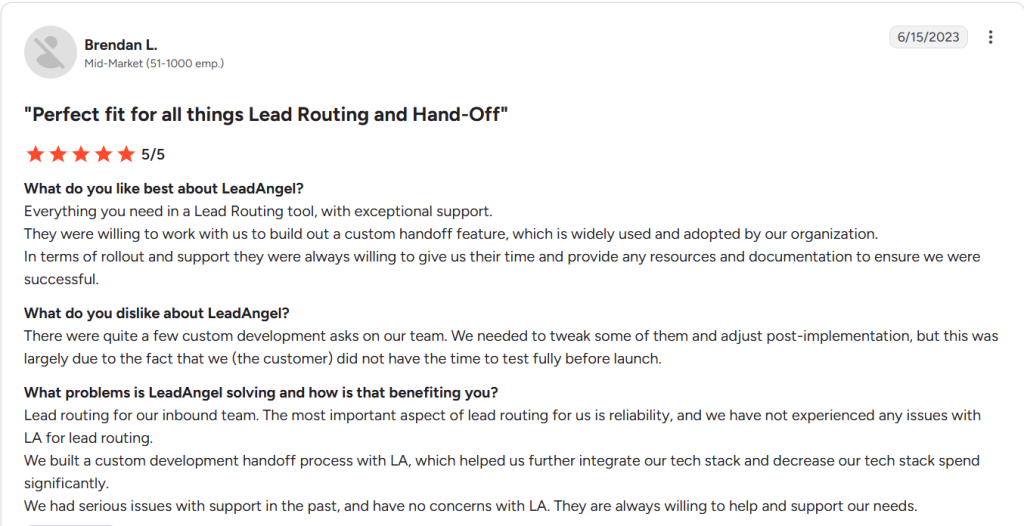
LeadAngel is an advanced lead routing software. It supports round-robin, weighted, territory-based, availability-based, fallback assignee based, and fully custom routing logic across Leads, Contacts, Accounts, and Opportunities, with SLA enforcement and audit-level routing logs.
Revenue Hero offers balanced and collective round-robin, fallback redistribution for unfilled meeting slots, and custom lists — but the routing decisions are scoped to the inbound conversion path, from form fill to booked meeting, rather than ongoing CRM object orchestration.
It’s worth distinguishing RevenueHero’s fallback redistribution (what happens to an unfilled slot) from its Vacation Management (what happens when a rep is OOO); LeadAngel’s closest equivalent to both is its Fallback Assignee rule, which reroutes at the point of assignment rather than the calendar.
Source: https://www.g2.com/products/leadangel/reviews/leadangel-review-8220604
Data Deduplication & Hygiene
LeadAngel’s Data Dedupe is a dedicated deduplication system. It merges, deletes, or converts duplicate lead and account records. It is a crucial metrics for most RevOps teams that manage large and multi-source CRM databases.
RevenueHero’s native enrichment feature fills in missing lead data using providers like Clearbit, Apollo, and Crustdata, which addresses incomplete records but isn’t built to solve duplicate-record cleanup the way LeadAngel’s dedupe engine is.
LeadAngel Vs RevenueHero Pricing Comparison (2026)
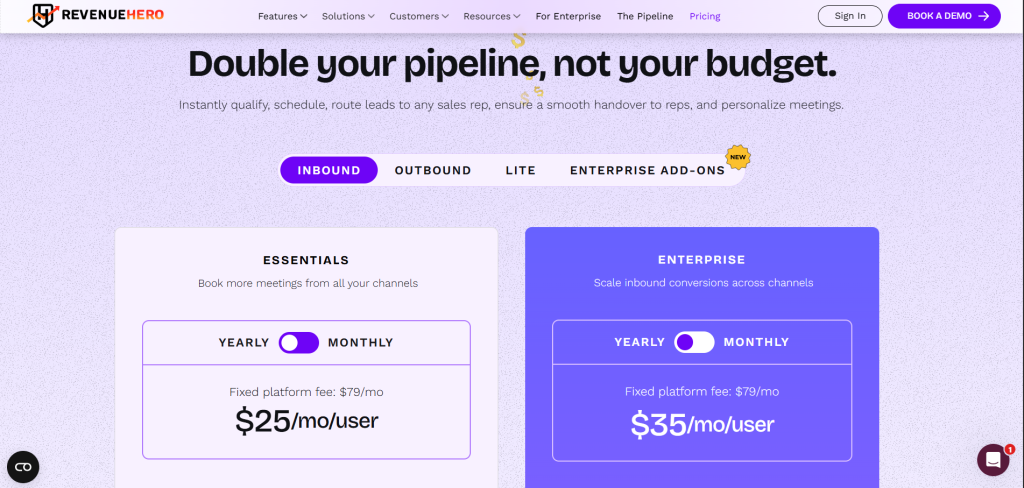
RevenueHero prices per user per month, with inbound plans adding a fixed platform fee on top. The plan starts from-
- Lite- $15/user/mo
- Outbound- $20/user/mo
- Inbound- $25/user/mo to $35/user/mo + $79/mo platform fee (annual billing)
Third-party sources quote RevenueHero pricing 2026 inconsistently, from $25 to $45/user/month, since total cost depends on the plan mix and add-ons like spam prevention or enrichment.
LeadAngel prices are based on the basis of custom tier pricing. It offers two-tier plans-
- Professional– Includes 2 way account matching, lead routing and email/portal based support
- Professional Plus– Offers lead, account, contact, and opportunity routing, data deduplication, and ScheduleNow for Hand-off and Web forms.
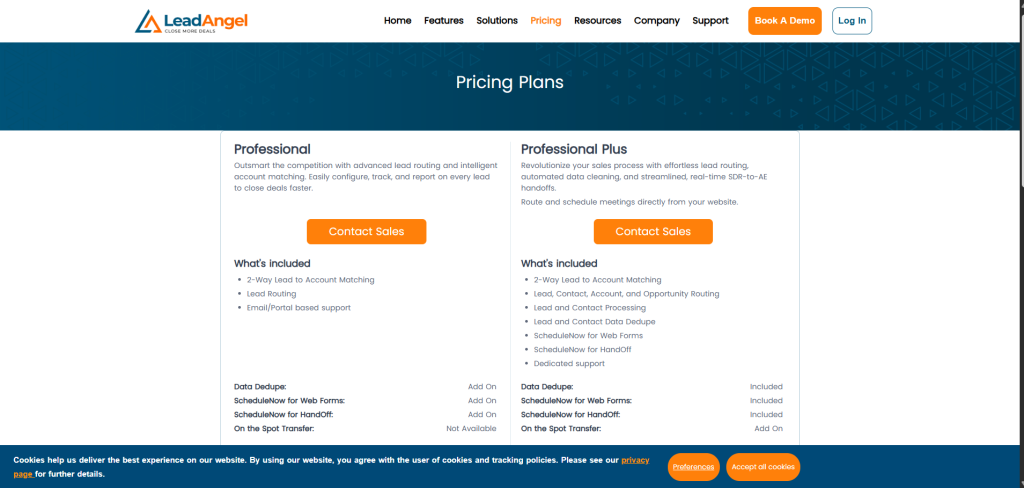
Both carry a one-time setup fee, with add-ons like Data Dedupe and ScheduleNow available on top.
| Criteria | LeadAngel | RevenueHero |
|---|---|---|
| Criteria | LeadAngel | RevenueHero |
| Pricing model | Custom pricing | Per user/month |
| Entry price | Contact sales | $15/user/mo |
| Add-ons | Data Dedupe, ScheduleNow, On-the-Spot Transfer | Spam prevention, enrichment |
Who should use LeadAngel?
LeadAngel is suitable for RevOps and Sales Ops teams whose routing problem has outgrown a simple round-robin rule inside the native CRM. Typically, organizations that run Salesforce alongside HubSpot or Microsoft Dynamics 365, which manage territory logic across regions, and need routing to fire across Leads, Contacts, Accounts, and Opportunities.
This fits you if:
- You run more than one CRM (Salesforce + HubSpot/Dynamics 365)
- Territory or account-ownership rules span multiple regions
- Routing needs to extend beyond Leads to Contacts, Accounts, and Opportunities
- Duplicate account records are causing misrouted or misassigned leads
Let’s understand the use case.
A 200-person SaaS org has enterprise sales in Salesforce, marketing-sourced leads landing in HubSpot. Give it a few years of reps and marketers all typing company names into forms their own way, and the same account is sitting in the CRM three or four times — a stray comma here, a subsidiary name there. Nobody did that on purpose. It’s just what happens.
The problem surfaces when an AE spends three weeks nurturing a “new” lead and then finds out in a pipeline review that it’s an account a teammate already owns. That’s not a fun conversation, and there are plenty of such cases.
A standard CRM router isn’t built to catch that — it’s matching on exact strings, so near-duplicates sail right past it. LeadAngel’s lead to account matching is built for exactly that mess, because it provides 99.7% accuracy according to SaasWorthy. Data Dedupe clears out whatever backlog is already sitting in the system, and the same matching logic follows the account through to Opportunities as the deal moves, not just at the point of lead capture.
LeadAngel cites a RevOps leader who saved over $250,000 a year after consolidating onto the platform, most of it from work their team used to do by hand, reconciling accounts.
Who Should Use RevenueHero?
RevenueHero fits demand gen and inbound-focused teams where the primary conversion bottleneck sits between the form submission and the booked meeting — not inside the CRM’s object model. That’s typically a HubSpot-first or Salesforce-first team running paid and organic inbound campaigns, where every second of delay between form-fill and calendar-slot costs pipeline.
Scenario: A Series B SaaS company runs a single HubSpot instance, drives demo requests through paid search and content, and has a lean team of eight AEs. Their bottleneck isn’t multi-object routing complexity — it’s that prospects fill out a form, wait for a follow-up email, and half of them never book.
RevenueHero’s instant qualification and sub-one-second scheduling widget close that gap in the same session as the form submission. Freshworks reported a 57% increase in bookings after implementing Revenue Hero, and Hippo Video cut inbound response time by 50% after switching to the platform — both outcomes tied directly to the speed of the booking flow rather than routing sophistication.
Conclusion
Comparing LeadAngel vs RevenueHero as if they compete for the same budget line misreads what either platform is for. LeadAngel wins the routing and data-integrity argument at scale — multi-CRM, multi-object, fuzzy-matched, and audit-traceable. RevenueHero wins the speed-to-meeting argument for inbound-heavy, single-CRM teams where the widget’s load time is the whole ballgame.
The teams that get this decision wrong are usually the ones that let the RFP(request for proposal) ask “which tool has more features” instead of asking where their actual bottleneck lives — in the CRM’s data model, or in the calendar. Answer that question first, and the choice between LeadAngel and RevenueHero mostly answers itself.
If you are evaluating RevenueHero and need enterprise routing depth, treat LeadAngel as the clearer RevenueHero alternative for RevOps—or as the platform that pairs with an inbound scheduler when booking UX and CRM governance must both be excellent.
*Disclaimer: All third-party names, logos, content, and trademarks are the property of their respective owners. These references do not imply endorsement.
See How LeadAngel Can Transform Your Lead Management
Curious to experience the power of LeadAngel firsthand? We understand!
We're offering a complimentary trial so you can explore LeadAngel's features at your own pace. Once you request a free trial, we'll schedule a personalized onboarding session to ensure you maximize the value of LeadAngel.
Ready to take your lead management strategy to the next level? Request your LeadAngel trial today!
In addition to exploring the platform, we recommend visiting our LeadAngel Help Center for in-depth guidance. Our dedicated customer support team is also available to answer any questions you may have at sales@leadangel.com.
FAQs
LeadAngel is a CRM-native routing, account-matching and meeting scheduling tool built for multi-object, multi-CRM RevOps workflows. Revenue Hero is an inbound scheduling tool that convert form-fills into booked meetings immediately. They solve adjacent but different problems.
RevenueHero, also referred to as Revenue Hero, qualify lead, routes them, and schedule meetings from inbound web forms. It replaces the manual efforts of email scheduling with a real-time booking widget embedded directly on a company's website.
RevenueHero pricing starts at $15–20/user/month for Lite and Outbound plans. Inbound plans includes a fixed $79–99/month platform fee on top of $25–45/user/month. It depends on your tier and billing cycle.
Yes. LeadAngel natively connects with Salesforce, HubSpot, and Microsoft Dynamics 365. It route and match leads across all three without pulling records out of the CRM for external processing.
Not for complex, multi-CRM, multi-object routing. RevenueHero's routing logic is scoped to the inbound form-to-meeting path. Teams needing territory management or Opportunity-level routing typically need a dedicated engine like LeadAngel.
LeadAngel is generally the better fit for enterprise RevOps teams running multi-CRM environments with complex territory and object-level routing needs. Revenue Hero suits leaner, inbound-focused teams prioritizing booking speed.