Key Takeaways
- Lead routing and lead distribution stop being simple once territories, ownership rules, and SDR teams start expanding
- LeadAngel is purpose-built for precision lead routing, Lead to account matching and RevOps orchestration inside complex CRM environments.
- LeadSquared is stronger for lead engagement, automation, and inbound sales execution
- The faster an intelligent lead distribution becomes essential once ABM, Salesforce workflows, and enterprise accounts enter the picture and the company scales, the more lead routing accuracy starts influencing pipeline health and revenue efficiency
If you search for “LeadAngel vs LeadSquared” or “best lead routing software,” you’ll find a lot of comparison pages that all start sounding the same after a while.
There’s usually a giant feature table. A few screenshots. Some vague claims about “streamlining workflows.” Then both products somehow end up being “perfect for growing businesses.”

That’s not really how software decisions work in real life.
At some point in every growing B2B sales organization, lead routing stops being a background task and starts showing up in revenue reports as a problem.
Most companies don’t start looking for lead routing software because everything is going smoothly. They start looking because something in their sales process is quietly falling apart.
Leads are getting assigned to the wrong reps. Enterprise accounts are being contacted by multiple SDRs. Territories overlap. Salesforce workflows become impossible to manage. RevOps teams spend half their week fixing routing problems manually.
At first, none of this feels serious.
A small sales team can survive with a simple round robin setup and a few assignment rules inside the CRM. But growth changes the equation very quickly.
More reps join. New regions open up. Ownership structures become more layered. Marketing launches more campaigns. Suddenly, the routing logic that worked six months ago stops working entirely.
That is the operational moment when most teams start evaluating platforms like LeadAngel and LeadSquared..
Even though both platforms live in the broader lead management category, they’re solving very different operational problems.
One focuses heavily on sales execution and marketing workflows.
The other focuses heavily on routing intelligence and RevOps infrastructure.
That distinction matters more than most comparison articles make it seem.
This comparison is written for RevOps leaders, Sales Ops teams, SDR managers, and Salesforce admins who are past the basic CRM rules stage and need to understand what these platforms actually do differently at the infrastructure level
LeadAngel vs LeadSquared at a Glance
The easiest way to understand the difference between these two platforms is to look at what they’re actually designed to optimize.
LeadSquared is built to help businesses capture leads, automate engagement, and manage sales activity from one central system.
The platform combines CRM functionality, marketing automation, lead nurturing, sales tracking, and workflow automation into a single operational environment. For many businesses, especially high-volume inbound teams, that simplicity is the biggest advantage.
You don’t need multiple systems stitched together just to manage campaigns and follow up with prospects.
LeadAngel takes a completely different approach.
Instead of trying to become an all-in-one sales platform, LeadAngel focuses deeply on one operational challenge: routing leads accurately at scale.
That sounds smaller on paper than “sales automation,” but it becomes incredibly important once companies grow beyond a handful of sales reps.
Because lead routing complexity compounds fast.
What starts as “assign leads by geography” eventually turns into layered ownership models, named accounts, territory exceptions, enterprise overlays, SDR handoffs, and account-based routing structures that are difficult to manage manually.
A lot of companies think they need better lead management software when what they actually need is better routing infrastructure.
That’s where the difference between these two platforms becomes very noticeable.
Quick Comparison: LeadAngel vs LeadSquared
| Category | LeadAngel | LeadSquared |
|---|---|---|
| Primary Focus | Lead routing & RevOps automation | Sales & marketing automation |
| Best Fit | B2B SaaS & enterprise teams | SMBs & inbound-heavy teams |
| Salesforce Alignment | Deep native support | Standard CRM integration |
| Lead-to-Account Matching | Advanced | Basic |
| Territory Management | Highly customizable | Basic rules |
| SDR-to-AE Handoff | Real-time, rule-based | Workflow-based |
| Round Robin Routing | Advanced (capacity + weighting) | Basic |
| Partner/Channel Routing | Supported | Limited |
| Scheduling | Native + integrations | Workflow follow-ups |
| Data Deduplication | Advanced | Basic |
| Marketing Automation | Integrates with tools | Built-in |
| Routing Flexibility | High | Moderate |
| Complexity Handling | Built for complex RevOps | Best for simple workflows |
The short version is pretty simple.
LeadSquared helps businesses manage leads.
LeadAngel helps businesses control how leads move across revenue teams.
Those sound similar until you’re managing a complex sales organization.
Then they feel very different.
What Is LeadAngel?
LeadAngel is a lead routing and RevOps platform built for B2B organizations operating inside complex CRM environments.
The important phrase there is complex CRM environments.
Because most companies don’t realize how fragile their routing process actually is until scale exposes the cracks.
A company launches a new territory. An enterprise account changes ownership. Marketing creates a regional campaign. SDR responsibilities shift. Suddenly, the old assignment workflows stop making sense.
Now RevOps is maintaining routing logic across spreadsheets, Salesforce rules, Slack messages, and manual exceptions.
That situation is surprisingly common.
LeadAngel is designed to centralize that operational complexity.
The platform allows teams to create advanced routing rules based on territories, account ownership, company size, product lines, geography, rep availability, and CRM objects.
But routing is only part of the story.
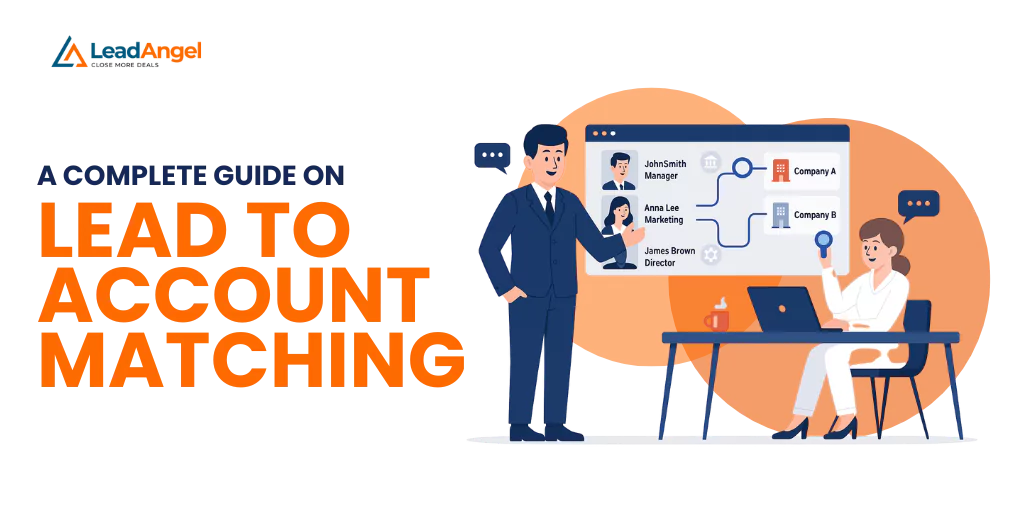
One of LeadAngel’s biggest differentiators is lead-to-account matching.
That feature becomes extremely valuable once companies move toward account-based sales strategies, also in industries like healthcare, financial services, and real estate. Instead of treating every inbound lead like a brand-new opportunity, the platform automatically checks whether that lead already belongs to an existing account inside the CRM.
That helps prevent duplicate outreach, ownership confusion, and awkward customer experiences where multiple reps contact the same company at the same time.
It sounds like a small operational detail.
In practice, it affects pipeline quality, customer experience, and sales efficiency in a very real way. It is highly rated by users for its accuracy and automation capabilities, as reflected in feedback on G2 reviews for LeadAngel.
What Is LeadSquared?
LeadSquared is a sales execution and marketing automation platform designed for businesses managing large volumes of inbound leads.
Compared to LeadAngel, the platform is much broader in scope.
Instead of specializing deeply in routing infrastructure, LeadSquared combines lead capture, CRM functionality, workflow automation, campaign management, lead nurturing, and sales tracking into one system.
For many companies, that’s actually the better approach.
Not every organization needs highly sophisticated territory management or layered account ownership rules. A business generating thousands of inbound leads every month may care much more about response speed, campaign automation, and sales engagement than routing precision.
That’s where LeadSquared tends to perform well.
The platform is especially common in industries like education, etc., where operational simplicity and high-volume lead handling matter more than enterprise-grade routing logic.
And honestly, that positioning makes sense.
A regional education company and a B2B SaaS company may both use lead management software, but their operational challenges are completely different.
It is recognized by users for bringing structure to lead capture and enabling smoother sales operations, based on insights shared on G2 reviews for LeadSquared Sales CRM.
One needs engagement automation.
The other needs routing infrastructure.
LeadAngel vs LeadSquared: Feature-by-Feature Comparison
Lead Routing & Lead Distribution
This is where the operational difference between the two platforms becomes the clearest.
Most CRM systems can technically assign leads. That’s not the same thing as intelligent routing.
There’s a huge operational difference between:
“If country equals US, assign to Rep A”
and “Match this lead to the correct account owner unless the account belongs to a strategic territory override structure while balancing SDR capacity and regional coverage.”
The second example is much closer to how modern B2B sales organizations actually work.
LeadAngel is designed specifically for that kind of complexity. The platform allows routing logic to evolve alongside the business instead of collapsing every time territories or ownership structures change.
LeadSquared approaches lead assignment more as part of a workflow automation system.
That works well for businesses with simpler operational structures.
But once routing becomes strategic infrastructure instead of administrative automation, the gap between the two platforms becomes significant.
CRM Integration & Compatibility
A lot of companies evaluating lead routing software are already heavily invested in CRM like Salesforce. That changes what they actually need from a platform. Most mature RevOps teams aren’t trying to replace their CRM. They’re trying to make it smarter.
That’s one reason LeadAngel resonates strongly with CRM-centric organizations.
The platform operates inside existing CRM environments rather than trying to replace them. Businesses can maintain their CRM structure while adding more advanced routing logic, ownership syncing, territory alignment, and lead-to-account matching capabilities.
Instead of rebuilding operational workflows from scratch, teams extend the infrastructure they already have.
LeadSquared also integrates with CRM, but the philosophy is different.
The platform is positioned more as a centralized sales execution environment rather than a dedicated routing layer.
For businesses wanting an all-in-one operational setup, that can absolutely be beneficial.
Lead-to-Account Matching
Lead-to-account matching sounds like one of those technical features only RevOps people care about.
Until the lack of it starts causing expensive problems.
Imagine a company already exists inside your CRM. Someone from that company downloads a whitepaper. The system doesn’t recognize the relationship correctly.
Now, two separate reps begin outreach.
One AE already owns the account. Another SDR thinks it’s a brand-new lead. Reporting gets messy. Attribution breaks. Customer experience becomes awkward.
This happens constantly in growing B2B companies.
LeadAngel was designed specifically to solve that kind of operational friction.
The platform automatically aligns inbound leads with existing CRM accounts so ownership continuity stays intact.
LeadSquared focuses more heavily on lead engagement workflows and automation rather than deep account relationship mapping.
That difference becomes much more noticeable once companies move into account-based selling.
Territory Management & RevOps Workflows
Territory management usually starts simple in early-stage sales organizations. One region, a few reps, and basic geography rules inside the CRM.
Then the company grows.
And suddenly nobody fully understands why the leads route the way they do anymore.
One region is controlled through Salesforce rules. Another is managed through spreadsheets. Someone from RevOps manually fixes assignment conflicts every Friday afternoon.
This is the stage where specialized routing platforms become extremely valuable.
LeadAngel centralizes territory definitions, ownership logic, routing structures, and assignment workflows into one system with visual configuration and full audit history. Teams can test routing changes before deploying them. Territory definitions support zip codes, states, company attributes, product overlaps, and custom hierarchies — all managed without code.
LeadSquared supports workflow automation effectively, but it’s not fundamentally positioned as a territory orchestration platform for complex sales organizations.
That distinction matters more as businesses scale.
Partner and Channel Lead Routing
For companies with channel sales programs, LeadAngel supports dedicated partner routing capabilities: notifying external partners when leads are assigned to them, allowing partners to accept or reject leads with deal registration logic, and providing a partner-facing dashboard for lead status visibility.
This is a capability set largely outside LeadSquared’s design focus, which centers on direct sales and internal team workflows.
LeadAngel vs LeadSquared: Which Teams Should Choose Each Platform?
The comparison below is based on publicly available product information, documented platform capabilities, and visible positioning across both companies’ websites.
| Team Type | Best Fit | Why It Fits |
|---|---|---|
| B2B SaaS companies | LeadAngel | SaaS sales teams usually manage complex territories, SDR-to-AE handoffs, account ownership rules, and Salesforce-heavy workflows. LeadAngel is built for that operational complexity. |
| Enterprise sales organizations | LeadAngel | Enterprise teams often need advanced lead routing, lead-to-account matching, and territory management across large sales structures. |
| Salesforce-centric businesses | LeadAngel | Companies deeply invested in Salesforce typically need routing infrastructure that enhances existing CRM workflows instead of replacing them. |
| RevOps-led organizations | LeadAngel | RevOps teams managing ownership logic, routing accuracy, and operational visibility usually benefit from LeadAngel’s deeper customization and control. |
| High-volume inbound teams | LeadSquared | Teams handling large numbers of inbound leads often prioritize speed, engagement automation, and centralized lead management. |
| SMB sales teams | LeadSquared | Smaller teams often prefer an all-in-one platform that combines CRM, lead capture, and automation without requiring complex setup. |
| Education businesses | LeadSquared | Education companies frequently manage high inquiry volumes where follow-up automation and lead engagement matter more than advanced routing logic. |
| Healthcare businesses | Both platforms | Healthcare organizations can fit either platform depending on operational complexity. High-volume patient inquiry teams may prefer LeadSquared, while larger healthcare sales organizations with territory-based routing may benefit more from LeadAngel. |
| Real estate organizations | Both platforms | Real estate businesses focused on lead engagement and quick response workflows may lean toward LeadSquared, while broker networks or multi-region sales structures may require LeadAngel’s routing flexibility. |
| Companies with complex territories | LeadAngel | Businesses managing layered territories, named accounts, and ownership exceptions usually need more advanced routing infrastructure. |
| Companies wanting CRM + automation in one place | LeadSquared | Businesses looking for a simpler operational setup often prefer LeadSquared’s broader sales and marketing functionality. |
Final Verdict: LeadAngel vs LeadSquared
This comparison really comes down to operational maturity.
LeadSquared is designed to help businesses capture, manage, and engage leads efficiently from one platform.
LeadAngel is built to help businesses orchestrate how leads move across complex revenue organizations.
At smaller scale, those differences may not feel dramatic.
At larger scale, they become impossible to ignore.
Because once sales teams grow, lead routing stops being a background workflow.
It becomes infrastructure.
And infrastructure problems compound quietly until they become very expensive.
If your business mainly needs marketing automation, lead engagement, and centralized sales workflows, LeadSquared offers a strong all-in-one operational platform.
But if your business depends on routing accuracy, territory alignment, Salesforce orchestration, and account ownership consistency, LeadAngel operates at a much deeper level operationally.
One platform helps teams manage leads.
The other helps revenue organizations route them intelligently at scale.
Most B2B organizations do not fail at lead management because they lack automation. They fail because routing decisions—which rep, which team, which territory, at what speed—happen inconsistently, invisibly, and without accountability. At a certain scale, that inconsistency becomes expensive.
If your RevOps team is spending time correcting routing exceptions that should be rules, that is a signal worth paying attention to.
*Disclaimer: All third-party names, logos, content, and trademarks are the property of their respective owners. These references do not imply endorsement.
See How LeadAngel Can Transform Your Lead Management
Curious to experience the power of LeadAngel firsthand? We understand!
We're offering a complimentary trial so you can explore LeadAngel's features at your own pace. Once you request a free trial, we'll schedule a personalized onboarding session to ensure you maximize the value of LeadAngel.
Ready to take your lead management strategy to the next level? Request your LeadAngel trial today!
In addition to exploring the platform, we recommend visiting our LeadAngel Help Center for in-depth guidance. Our dedicated customer support team is also available to answer any questions you may have at sales@leadangel.com.
FAQs
In most LeadAngel vs LeadSquared comparison discussions, the biggest difference is focus. LeadAngel specializes in lead routing, territory management, and RevOps automation, while LeadSquared focuses more on lead capture, sales engagement, and marketing automation.
For complex B2B sales organizations evaluating crm lead routing tools for b2b, LeadAngel is usually the stronger fit because it handles advanced routing and account ownership workflows more effectively.
LeadAngel offers advanced lead-to-account matching, territory-based routing, weighted round robin assignment, and deeper Salesforce-native routing logic that many standard lead management platforms do not support at the same depth.
In most revops tools comparison evaluations, LeadAngel stands out because it’s designed specifically for RevOps teams managing territories, routing logic, and account ownership structures at scale.
Usually yes. Since LeadAngel works alongside CRMs like Salesforce, most businesses can migrate routing workflows without losing core lead or account data.
Yes. LeadAngel is a strong choice for ABM because of its lead-to-account matching, ownership alignment, and routing accuracy capabilities. Every inbound lead is automatically checked against existing CRM accounts before routing—ensuring leads from ABM target accounts reach the correct owner rather than entering a generic inbound queue. This prevents duplicate outreach and preserves the account context ABM programs depend on.
For Salesforce-heavy environments comparing lead routing software comparison options, LeadAngel is generally the stronger choice because it extends Salesforce routing and RevOps workflows more deeply.
Yes. LeadSquared supports workflow automation and sales engagement features that can automate follow-ups and scheduling after lead capture.
For ABM strategies, LeadAngel is usually the better fit because it’s built around account ownership, territory alignment, and lead-to-account matching.
Yes. LeadSquared includes duplicate handling and lead management capabilities as part of its broader automation platform.
For businesses comparing the best lead management software for complex B2B operations, LeadAngel generally handles deduplication more effectively because it combines duplicate prevention with account matching and routing intelligence.