Key Takeaways
- Account-based marketing (ABM) focuses on high-value companies rather than a large number of individual leads. It helps you create personalized campaigns for the decision-makers at those companies.
- Marketing lead routing helps businesses send incoming leads to the right sales representatives based on different factors such as account ownership, location, industry, and lead qualification criteria.
- Account-based routing matches incoming leads with existing CRM accounts before assigning them. If a matching account exists, the lead is directed to its owner, helping maintain consistent communication with the company.
- Automating lead assignment reduces manual work and routing errors. It also helps sales representatives receive leads faster, allowing them to engage prospects while their interest is high.
- Regularly reviewing lead routing rules helps businesses identify assignment issues, improve sales and marketing alignment, and ensure that leads reach the right representatives. This supports more effective ABM campaigns and better use of sales resources.
Does your business lose valuable leads due to slow response times or misaligned sales efforts? Are you also struggling to connect with the right sales reps to engage with the correct accounts at the right time? Well, you are not alone, as these inefficiencies are more common and significantly impact your sales potential than you think.
Studies show over 70% of incoming leads are wasted primarily due to ineffective lead generation. Furthermore, 52% of outbound marketers report their marketing efforts as ineffective due to poor lead management.
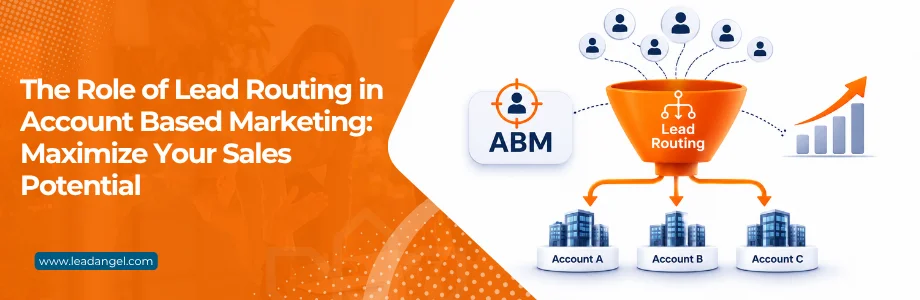
Without an effective system in place, businesses risk missing out on high-value opportunities and wasting resources on unproductive efforts. This is where lead routing can make all the difference. By automatically directing leads to the most qualified sales representatives based on predefined criteria. This helps businesses accelerate response times and maximise sales potential. In this article, we’ll explore how integrating lead routing into your account-based marketing strategy can drive better results and maximize your sales potential.
What is Account-Based Marketing?
Account-based marketing (ABM) uses a strategic approach and focuses on targeting high-value accounts. It customized campaigns to meet the specific needs, preferences, and challenges of decision-makers within the main accounts. Furthermore, ABM aims to deliver personalized experiences by prioritizing quality over quantity. This resonates with target accounts, fostering stronger relationships and driving better results.
However, implementing ABM is not without its challenges. Some common obstacles include
- Misalignment between sales and marketing teams, leading to inefficiencies
- Delayed responses to leads which can result in lost opportunities
- Generic messaging that fails to address the unique needs of target accounts
Thus, account-based lead assignment plays a crucial role. Businesses ensure that leads are assigned to the right sales representative based on predefined criteria by using intelligent lead routing solutions. The process helps improve the alignment of the teams while also accelerating response times and improving personalized messaging.
What Is Account-Based Routing?
Account-based lead routing is the practice of lead routing that uses accounts and account owners. In this technique, a lead is first matched to an existing Salesforce account, then routed to the account owner. This way, known leads go to the existing account owner, and only the leads that are completely new enter the general distribution method.
Who uses account based routing?
| Term | Why They Use It? |
|---|---|
| Enterprise B2B sales teams | To manage complex territories, long sales cycles, and multi-stakeholder buying groups |
| ABM / account-based sales teams | They need named-account ownership preserved so marketing and sales coordinate around the same target accounts. |
| Customer success and expansion teams | They route cross-sell and upsell signals to the current account owner or CSM |
| RevOps / Sales Ops | They use it to reduce duplicate records, routing disputes, and inconsistent account coverage |
| Partner- and channel-led organizations | They route leads based on account ownership, partner coverage, or account tier |
Many people use account-based routing and account based lead assignment interchangeably, thinking they are the same terms. So, let’s understand the difference between the two terms.
| Term | Its Emphasis |
|---|---|
| Account-Based Routing | It manages end-to-end routing workflow. It matches a lead to an account, applies ownership/status rules, and assigns or escalates it |
| Account Based Lead Assignment | In this step, only a specific assignment decision is taken. For example, “Which rep should receive this lead?” based on account ownership |
You might be thinking, if we are discussing a blog on “account based marketing”, then why is there a section on “account-based routing”? Are they connected to each other in some way? Do they impact each other?
The answer is yes! You can sum up the analogy between them easily. If ABM is the strategy, then account-based routing is the execution mechanism. ABM helps you shortlist the targeted account, and account-based routing makes sure those shortlisted accounts get connected with the right sales rep or account owner as quickly as possible.
Account-Based Lead Assignment vs Standard Lead Routing
| Criteria | Account based lead assignment | Standard lead routing |
|---|---|---|
| Primary unit | The company/account | The individual lead/contact |
| Assignment logic | Lead-to-account match, then route to the account owner or account team. | Field rules: region, source, industry, employee count, round robin, etc. |
| Assignment Basis | Account ownership, account relationships, and target-account status. | Geography, lead attributes, sales territory, or round-robin rotation. |
| Account Matching | Matches leads to existing CRM accounts before assignment | May assign leads without matching them to existing accounts. |
| Relationship continuity | Prioritizes continuity; contacts from the same organization reach the same owner. | Not guaranteed; two contacts from the same company may go to different reps. |
| Best fit | ABM, enterprise sales, named accounts, existing customers, complex buying committees. | High-volume inbound, new logos, broad-market selling |
| Main dependency | Accurate account data, email-domain/company matching, and clear ownership. | Clean routing rules and rep availability |
| Main Benefit | Preserves account relationships and supports coordinated sales engagement. | Simplifies lead distribution and supports efficient handling of inbound demand. |
| How It Works | Matches an incoming lead to an existing CRM account, checks account ownership, and assigns the lead to the appropriate account owner or sales team. | Evaluates lead attributes such as location, industry, or company size and assigns the lead using predefined rules, territory-based routing, or round-robin distribution. |
| Best Approach for Larger B2B Teams | Use account-based assignment for existing and target accounts. | Use standard routing for unmatched leads, new accounts, or leads that need territory-based or round-robin distribution. |
| Potential Limitation | Incorrect account matching or outdated ownership data can lead to misassignments. | Rules that ignore account ownership can create fragmented communication with prospects from the same company. |
The Role of Lead Routing in Account Based Marketing
Lead routing acts as the most important component used for a successful account-based marketing strategy. It employs a timely and effective sales process to make sure only the high-value leads are assigned to the right sales representative.
Let’s explore how lead routing plays a central role in maximizing the success of Account based marketing
1. Aligning Sales and Marketing Teams
ABM faces challenges in aligning sales and marketing teams to work mainly on a common goal. It ensures that both teams can collaborate closely with the account-based lead assignment to define clear lead qualification criteria.
The alignment is responsible for making sure that all the leads are routed efficiently to the right sales reps to foster better communication and smooth transition between the teams. Working in a team with marketing and sales can nurture high-value accounts effectively, resulting in improved chances of successful conversations.
2. Accelerating Sales Response Times
Research shows contacting leads within the first 5 minutes increases the chances of conversion by up to 9%.
Efficient lead routing helps reduce response times, ensuring that leads are assigned to the right sales reps as soon as it is received. Quick response time helps in keeping the leads engaged ensuring high-value opportunities are not missed. Moreover, the faster your sales team acts, they are more likely to close deals and drive revenue.
3. Enhancing Personalization and Relevance
Personalization is at the heart of any account based marketing strategy. Lead routing helps ensure sales reps deliver customized experiences. Lead routing enables relevant and personalized interactions by giving detailed insights about each account’s preferences, pain points and decision making processes to sales reps.
This deeper understanding lets sales reps engage in meaningful conversations with the prospects by addressing their needs and goals. As a result, account based routing strengthens the relationship between sales teams and their prospects while increasing the conversion rates.
4. Optimizing Sales Resources
An effective lead routing system makes sure that sales representatives are matched with accounts that align with their expertise. Businesses can assign leads to the qualified individual by evaluating their skills, experience and past performance of sales reps.
This strategic approach to lead routing lets sales reps focus on high-value prospects, allocating time and resources efficiently, and developing tailored strategies. The result? More effective use of sales resources leads to higher conversion rates and a better ROI for ABM efforts.
5. Implementing Lead Routing Best Practices
It is essential to implement the best practices to optimize the lead routing process to streamline lead assignment, ensuring the prospects are engaged in the most efficient way possible.
Some of the best practices include:
Define → Automate → Align → Monitor and Adjust
- Define Lead Qualification Criteria: Creating a clear guidelines for a qualified lead ensures only the high-value prospects are routed to sales
- Automate Lead Assignment: Reduce manual errors and speed up lead distribution by using automation tools
- Align Sales and Marketing Teams: Encourage teamwork between sales and marketing to make sure both teams target the right accounts
- Monitor and Adjust Strategies: Track performance metrics and adjust lead routing strategy on a regular basis to improve results
Businesses can improve their lead routing process, improve the quality of sales interactions and reduce response times by implementing the best practices. This leads to higher conversion rates and better successful ABM campaigns.
ROI Impact of Lead Routing in Account Based Marketing
| Metric | Without Lead Routing | With Lead Routing | Improvement |
|---|---|---|---|
| Lead Response Time | 2 hours | 15 minutes | 87.5% faster |
| Conversion Rate | 15% | 25% | +10% |
| Revenue Growth | $500,000 | $750,000 | +50% |
How Lead Routing in ABM Maximizes Sales Potential
Efficient lead routing in ABM is the key to unlock the full potential of the sales teams. Here’s how it helps in maximizing the sales potential:
- Improves Lead Quality: Prioritize the high-value accounts, so the team can focus only on the leads that matter the most. This step is necessary to avoid the amount of time wasted on low-priority prospects.
- Prioritizing High-Value Accounts: By prioritizing high-value accounts, your team will focus on the leads that matter the most.
- Improved Sales Efficiency: Make sure the leads are assigned to the most suitable sales reps. When all the opportunities are handled by the best person, the chances of closing the deal is more.
- Boosts ROI: Companies see an increase in ROI due to better resource allocation and more targeted sales efforts by using lead-based marketing along with routing.
For instance, a B2B SaaS company that implemented automated account based lead routing experienced a 40% improvement in conversion rates, demonstrating the power of a well-optimized lead routing system.

Benefits of Enabling Account Based Lead Routing
| Pros | Description |
|---|---|
| Optimized Resource Allocation | Matches account with the right sales reps based on expertise |
| Improved Response Times | Ensures leads are contacted promptly to maintain engagement |
| Enhanced Personalization | Tailors interactions to specific account needs |
| Higher Conversion Rates | Focuses on high-value leads for better ROI |
- Optimized Resource Allocation
By analyzing sales reps’ expertise, businesses can align them with accounts matching their strengths. This leads to better-targeted efforts and increased conversions. - Streamlined Workflow
Automation eliminates manual errors and ensures leads are directed instantly to the right representatives. - Improved Lead Nurturing
With lead routing in ABM, reps gain access to detailed data helping them nurture accounts with relevant content and offers. - Higher Revenue Growth
Companies reported up to 20% increase in revenue with advanced account-based lead assignment when compared to their competitors.
Unlocking Sales Success with Lead Routing in ABM
Lead routing is a critical aspect of account-based marketing, maximizing sales potential by aligning sales and marketing teams, accelerating response times, enhancing personalization, optimizing resources and implementing best practices.
By focusing on the key areas, businesses can streamline lead management ensuring the right sales representatives engage with high-value accounts and drive significant results. Using the power of lead routing in ABM allows organizations to unlock their true sales potential and achieve greater success in converting prospects into customers.
LeadAngel’s proprietary AI and machine learning algorithms provide an unmatched lead routing experience across industries. Interested in learning how we can help your organization meet its targets? Book a demo call today.
See How LeadAngel Can Transform Your Lead Management
Curious to experience the power of LeadAngel firsthand? We understand!
We're offering a complimentary trial so you can explore LeadAngel's features at your own pace. Once you request a free trial, we'll schedule a personalized onboarding session to ensure you maximize the value of LeadAngel.
Ready to take your lead management strategy to the next level? Request your LeadAngel trial today!
In addition to exploring the platform, we recommend visiting our LeadAngel Help Center for in-depth guidance. Our dedicated customer support team is also available to answer any questions you may have at sales@leadangel.com.
FAQs
Lead routing streamlines the process of assigning leads to the right sales reps ensuring that the best person is handling each opportunity. This reduces response times, improves the quality of interactions and increases the chances of closing deals, resulting in boosting sales efficiency.
Lead routing ensures that sales reps have access to detailed insights about each account’s preferences, pain points and decision-making processes. This allows sales teams to engage with leads in a more personalized and relevant way, increasing the chances of conversion.
Yes, lead routing can be fully automated using AI-powered tools like LeadAngel. Automation reduces manual errors, accelerates lead distribution and ensures that leads are assigned to the right sales reps in real-time.
Lead routing helps align sales and marketing teams by ensuring that both teams are working towards the same goal: targeting high-value accounts. By defining clear lead qualification criteria, lead routing encourages better collaboration between teams and improves overall efficiency.
As you all know, ABM helps target specific accounts. For example, a software company is trying to target Microsoft as its potential client. So, account based marketing strategy helps the marketing team create personalized campaigns for the key decision-makers at Microsoft; they can share relevant case studies or send personalized emails. On the other hand, the sales team tries to reach out to the stakeholders and demonstrate to them how their software can actually help Microsoft.